
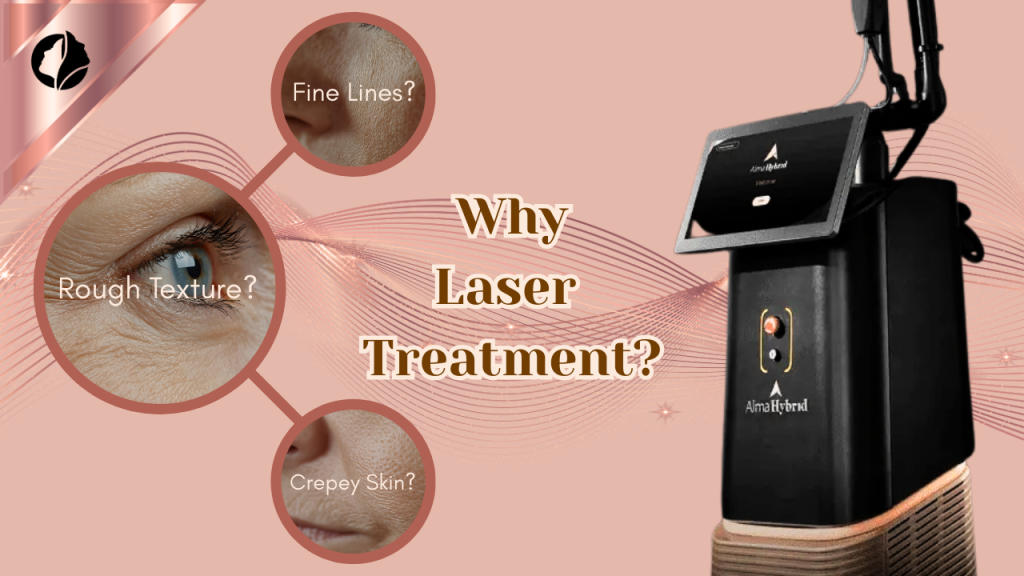
Laser resurfacing is the most effective modality to treat wrinkles and thus improve skin texture. Laser resurfacing can be safe if performed with: proper precaution, parameters, technique and post-procedure care.
Proper precaution starts with patient selection. Good candidates are generally those of Fitzpatrick I-III and with fine lines and crepey skin. Individuals with higher Fitzpatrick or history of hyperpigmentation may undergo laser resurfacing, but conservatively. Individuals with isotretinoin treatment within six months, active herpes, dermatitis or skin infection, and incomplete blinking or eye closure should avoid laser resurfacing.
Proper precaution also includes pre-procedural preparation. For individuals with Fitzpatrick skin type IV or higher or history of post-inflammatory hyperpigmentation or melasma, I pre-treat with Hydroquinone 4% or greater for at least four weeks prior to the laser treatment to suppress the tyrosinase activity in melanocytes. (Tyrosinase is the enzyme that initiates melanin production in the melanin producing cells, melanocytes.) For all patients, I ask them to avoid sun exposure, tanning (including self-tanner), chemical peels, waxing, or laser hair removal of the area to be treated, and photosensitizing drugs (i.e. Doxycycline or of the same class) for four weeks prior to laser treatment and discontinue retinoids, glycolic acid, salicylic acid, and other exfoliating agents one week prior to laser treatment. I also pre-treat most of my patients with anti-viral medication one day before and then after laser for a full week course to prevent herpes simplex outbreaks. For the day before laser, I encourage patients to hydrate well (1-2 liter of water) and moisturize the skin daily to promote healing and minimize dryness post-procedure.
The most important safety precaution on the day of procedure is eye protection. For treatment of the eyelids, an ocular anesthetic drop, lubricating ointment and then a metal corneal shield are placed directly on the cornea.
Safety precaution includes keeping patients comfortable during the procedure. This is to avoid sudden movements during lasering. I use Benzocaine 20%/Lidocaine 10%/Tetracaine 10% cream over the treated area. I also like to use oral anxiolysis. This combination has worked very well for my patients.
Equally crucial to proper precaution are safe parameters and techniques. Certain skin types and concerns, like Fitzpatrick I and II and significant crepey skin and perioral fines lines, respectively, may allow for aggressive laser resurfacing, something I consider as non-surgical facelift. However, for all other skin types and concerns, I would adjust the energy level, duration and density and still perform two passes. Given the thinner skin of the eyelids, I also reduce the energy and duration. With the newest technology in laser resurfacing, our Alma Hybrid really allows for adjusting the settings to appropriate the treatment to all skin types and indications.
Proper techniques come from experience and mindfulness. For example, during procedure, the non-dominant hand constantly keeps traction on the skin to stretch the skin taut, while the dominant hand controls the handpiece. A safer technique includes avoid stacking the pulses in the same spot. For CO2, the endpoint is even, light frosting over mild erythematous skin.
Aside from pre and during procedural precautions, post procedural care also makes a significant difference. While expect redness, swelling, sunburn-like sensation, crusting, flaking and oozing, we can minimize the adverse events by avoiding picking, rubbing, or peeling flaking skin. On the day of procedure, we ask patients to splash luke-warm water and gently pat dry. For the day of and after, I have patients apply diluted vinegar-soaked gauze on the treated area for ten minutes and the Barrier Restoring Crème. I also have patients use the Alma CBD post-treatment kit until all of the scabbing, flaking and peeling resolves. The kit aid in healing. Avoiding direct sun onto the treated skin after laser also aid in healing and prevent adverse events.
Other post-procedural care include activities to avoid. I ask patients to refrain from exercises, saunas, steam rooms, hot tubs, make-up or any other topicals the first week of procedure or until crusting, peeling, and oozing resolve. I also ask patients to sleep on their back with head elevated at 45 degrees for the first week or until swelling resolves.
If we do all of the above, laser is safe and effective. It is the best modality for crepey skin and static fine lines, especially of the lower eyelids and around the lips.
Leave a Reply