
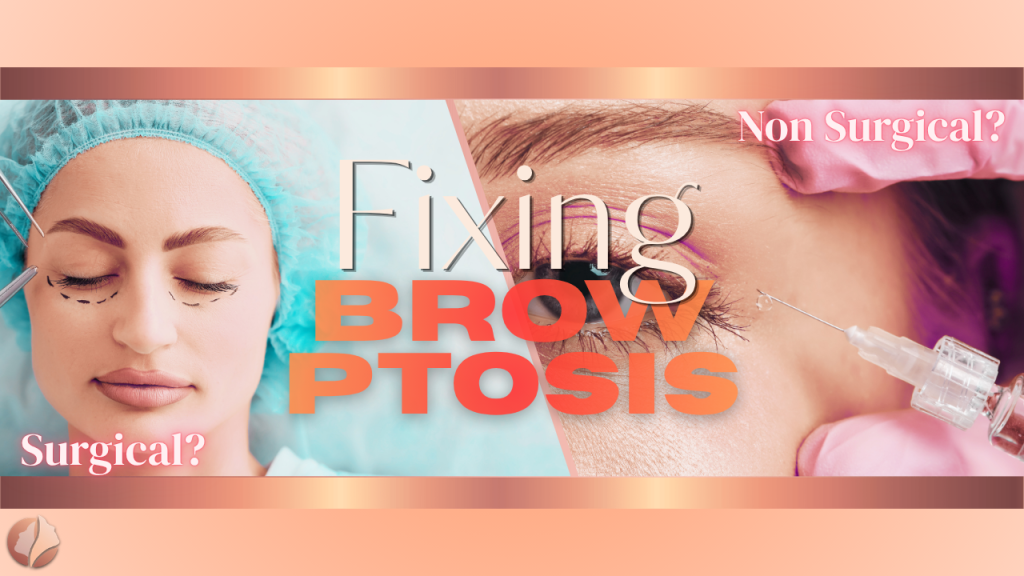
What is brow ptosis?
The eyes may be the focal point of the face, but the brows play an equally important role in how rested, youthful, and open the upper face appears. When the brows begin to descend, they can create heaviness of the upper eyelids, contribute to hooding, and make the eyes look tired or stern. This descent is known as brow ptosis.
What causes brow ptosis?
The brows droop gradually and for two main reasons. First, over time, the frontalis muscle in the forehead can thin and become less effective. The frontalis is the main muscle that elevates the brows. As it weakens, the brows gradually descend from their natural position. That natural brow position differs between women and men. In women, the brows are typically at or above the superior orbital rim, while in men they are usually lower and flatter along the rim. The superior orbital rim is the upper edge of the bony eye socket.
The second factor is gravity. Over time, gravity pulls the soft tissues of the forehead and brows downward.
How brow ptosis affects the eyelids?
As the brows descend, they push into the upper eyelid folds. This can make the eyelids look heavier, fuller, and more hooded. In some patients, this heaviness is even more noticeable because of naturally thick skin or heavier soft tissue in the brow and eyelid area. When the brows descend beyond their natural balance point, the upper face can begin to look heavy, fatigued, or less vibrant.
How to fix brow ptosis?
The good news is that brow ptosis can be treated. Treatment options range from minimally invasive to surgical, depending on the degree of droop, the patient’s anatomy, and the desired result.
Non-surgical Brow Lift
1. Chemical Brow Lift
The least invasive treatment is a chemical brow lift using neuromodulators such as Botox, Dysport, or Daxxify.
This works by weakening the muscles that pull the brows downward, allowing the frontalis muscle to elevate the brows more effectively. These injections are typically placed strategically in the glabella, lateral brow, and crows feet, where brow depressor muscles are active.
A chemical brow lift can provide a subtle improvement, but the lift is limited, usually no more than 2 mm. The effect is temporary and typically lasts about 3 to 4 months, after which treatment must be repeated.
A chemical brow lift is ideal for those seeking:
- A very subtle improvement
- No surgery
- Minimal downtime
- Temporary enhancement
2. Suture Brow Lift
The next option is a suture brow lift, which is more involved than injections, but much less invasive than surgery.
In this technique, specially designed sutures with barbs or hooks on the surface are placed beneath the skin of the forehead to elevate and support the brow. This produces a mild lift that generally lasts longer than neuromodulators, often up to one year. While the improvement is modest, it is a good option for selected patients seeking some enhancements while not yet ready for surgery.
Surgical Brow Lift
For more significant brow ptosis, surgical brow lift offers the most definitive and longer-lasting correction. The goal is to restore the position of the brows to achieve appropriate height, balance and harmony. There are several surgical approaches, and the best technique for each individual depends the severity of the droop, facial anatomy, hairline skin quality, brow shape and aesthetic goal.
1. Brow Lift from Behind the Hairline
In this approach, 2 to 3 cm incisions are made about 1 cm behind the hairline above each brow arch and behind each temple. Through these incisions, the soft tissues of the forehead are carefully released from the underlying bone, extending from the incision to beneath the brows and across the forehead from temple to temple. Once the tissues are fully mobilized, they are elevated and secured to fixation devices anchored to the bone behind the hairline. Additional sutures may be used to elevate the brow tail.
The benefits of this approach include:
- Incisions hidden within the hair
- Effective elevation of the brow arch and lateral brow
- Forehead lengthening, which may benefit patients with a short forehead
Potential downsides include:
- Hair thinning near the incisions
- Further forehead lengthening in patients who already have a high forehead
- Risk of facial nerve injury, although this is uncommon
One limitation of this approach is that it does not address the medial brow, or brow head, as effectively as some other techniques.
2. Direct Forehead Lift Through Forehead Wrinkles
For patients with deep forehead rhytids, incisions can sometimes be placed within these wrinkles so the scars are better camouflaged.
Through these incisions, the tissues are released down to below the brows. A predetermined amount of skin and soft tissue are then excised, based on how much elevation is needed. Sutures may also be used to support the brow tissues and improve suspension.
This method can provide:
- A stronger lift than some of the other methods
- More uniform elevation across the brow, including the brow head
- A somewhat less extensive operation than the above full subperiosteal brow lift
Potential risks include:
- Numbness or tingling above the incision, which may last up to 6 months (or indefinitely in a small percentage of patients)
- Redness of the scar during the early healing period
When forehead wrinkles are deep, the scar is often well concealed. If the scar remains noticeable, laser resurfacing may help improve its appearance.
3. Direct Brow Lift at the Upper Brow Margin
For patients with thick eyebrow hair, an incision can sometimes be placed directly along the superior border of the brow.
Skin and soft tissue are excised just above the brow according to the amount of lift needed. In some cases, supporting sutures are also used to suspend the brow further. The incision is then closed in layers.
This approach offers:
- The most powerful and precise lift
- Excellent control of brow position and symmetry
However, potential downsides include:
- A visible scar
- Numbness or tingling
- A more rounded brow shape
In patients with dense brow hair, the scar is often well camouflaged and can also be concealed with eyebrow pencil.
When evaluating and considering correction of heavy, sagging upper eyelids, it is essential to look at the position of the brows. If brow ptosis is contributing to the heaviness and is not recognized, treating the eyelids alone may lead to suboptimal results, persistent heaviness, and disappointment—unaddressed brow ptosis is the most common reasons for underwhelmed satisfaction after blepharoplasty. Proper diagnosis is key to choosing the right treatment and achieving a natural, balanced outcome.
Which brow lift is the right one for you?
The best treatment for brow ptosis depends on several factors, including the severity of brow descent, forehead length, hairline position, skin quality, tolerance for scars, downtime, how much elevation, how long you want the result to last and your tolerance for more or less surgery and risk of surgery. During consultation, a careful exam can determine whether brow ptosis, eyelid ptosis, excess eyelid skin, or a combination of these is responsible for the heavy appearance around the eyes. When all of the problems are recognized and careful addressed, the result is not surprised or overly done, but rather a softer, brighter and more rested version of you
Leave a Reply